Warning

WARNING! These reviews all contain SPOILERS!!!!

Sunday, December 17, 2017

"Love Is Forbidden, We Croak and Howl"

by Caitlin R. Kiernan
originally published Sirenia Digest #78, 2010

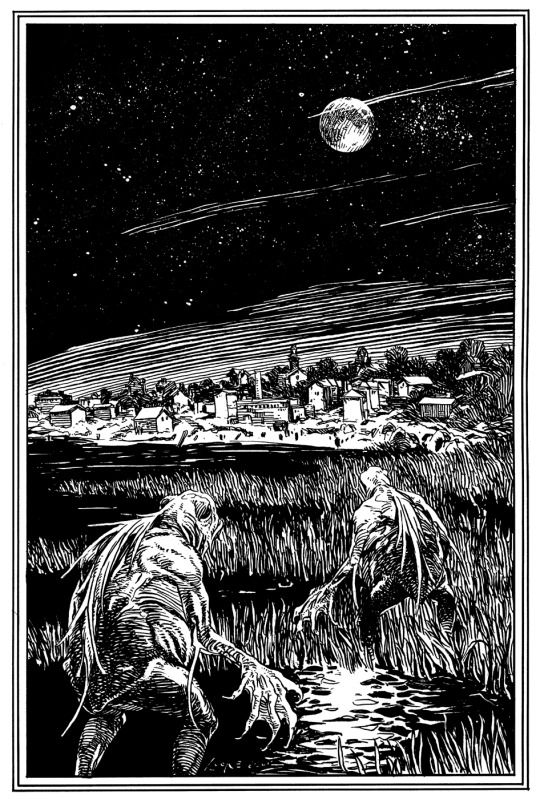
A ghoul living near Innsmouth spies an Innsmouth girl named Elberith Gilman. It goes to her house at night.  She awakes and sees it at her window.  She lets it in and takes its hand.

Certainly weird, and effectively written.  But this is little more than a vignette.


"The Doom That Came To Sarnath"

Jason Thompson - mockman.com
by H.P. Lovecraft
originally published The Scot, June 1920

(from Wikipedia) According to the tale, more than 10,000 years ago, a race of shepherd people colonized the banks of the river Ai in a land called Mnar, forming the cities of Thraa, Ilarnek, and Kadatheron (not to be confused with Kadath), which rose to great intellectual and mercantile prowess. Craving more land, a group of these hardy people migrated to the shores of a lonely and vast lake at the heart of Mnar, founding the metropolis of Sarnath.

But the settlers were not alone. At the other side of the lake was the ancient, grey-stone city of Ib, inhabited by a queer race who had descended from the moon. Lovecraft described them as "in hue as green as the lake and the mists that rise above it.... They had bulging eyes, pouting, flabby lips, and curious ears, and were without voice."

These beings worshipped a strange god known as Bokrug, the Great Water Lizard, although it was more their physical form that caused the people of Sarnath to despise them.

The people of Sarnath killed all the creatures inhabiting Ib, destroyed the city and took their idol as a trophy, putting it in Sarnath's main temple. The next night, the idol vanished under peculiar circumstances, and Taran-Ish, the high-priest of Sarnath, was found dead. Before dying, he had scrawled a single sign on the empty altar: "DOOM".

Ten centuries later, Sarnath was at the zenith of its power and decadence. Nobles from distant cities were invited to the feast in honour of Ib's destruction. That night, however, the revelry was disrupted by strange lights over the lake and heavy greenish mists, and that the tidal marker, the granite pillar Akurion, was mostly submerged. Not too much later, many of the city's inhabitants fled, maddened by fear, as the king and the people in the feast had been transformed into the original creatures from Ib.

After this some of the survivors reported seeing the long-dead inhabitants of Ib peering from the windows of the city's towers, while others refused to say exactly what they had seen. Those that returned saw nothing of those unlucky enough to be left behind, only ruins, many water lizards, and most disturbingly, the missing idol. Ever since then, Bokrug remained the chief god in the land of Mnar.

Another early, Dunsany-ish tale.  This one clearly points to some ideas HPL will develop later.  It's not a great story, though - more a colorful sketch.


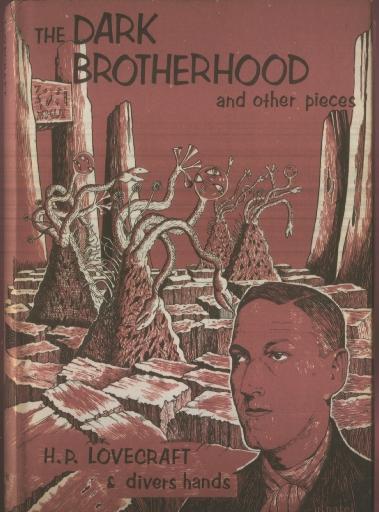
"The Dark Brotherhood"

by August Derleth

originally published The Dark Brotherhood and Other Pieces, Arkham House, 1966

Arthur Phillips is a bookish recluse who lives with his mom and aunts in Providence, RI.  He doesn't do much with his life and likes to take rambling walks through the city and surroundings, late at night.   He meets a girl named Rose Dexter who's as weird as he is, and the two take up late-night walks together.

One night they meet an odd man, dressed in a somewhat shabby, 19th century style, who wants to see "the cemetery where Poe once walked."  He seems to be interested in Poe, and in Providence, and calls himself Mr. Allan.  It is only after they've parted that Rose points out that Mr. Allan bears a striking resemblance to Mssr. Poe.

A couple nights later, as Arthur is on his way out for another stroll, he meets Mr. Allan again (Arthur has the feeling this is no accident).  Mr. Allan engages him in conversation about astronomy (Arthur writes an astronomy column for the local paper) and asks him if believes in life on other planets (Arthur does).  Mr. Allan asks if he and his brothers can come visit Arthur next Monday, whence they will offer proof of life on other planets.  Arthur, who apparently doesn't mind letting cranks into his house, agrees.  Mr. Allan takes his leave, but Arthur follows him home in secret.

He sees Mr. Allan enter the house, but no lights come on.  From his hiding place, a short time later, he sees Mr. Allan again come from the same direction as before, and enter the house.  How did Allan slip out of the house while he was watching? Puzzled, he leaves - only to encounter Mr. Allan out on the streets yet again! Even more oddly, Allan says nothing and take no notice of him.

Thing get weirder the next night.  It seems that she, too, encountered Mr. Allan on her night walk.  He walked her home, in fact. Arthur realizes that Rose must have been walking with her Mr. Allan at the same time as he was walking with his Mr. Allan.  Huh?

Well, some solution is offered next Monday, when seven identical Mr. Allans show up at Arthur's door, and gather in a circle with him, in order to "produce certain impressions of extra-terrestrial life."

What they end up showing him is a kind of hologram of the Great Race farting around with some glowing cubes.  This freaks Arthur out no end.  

The next day, Arthur heads over to the Allans' house.  Since no one answers the door, he lets himself in.  The house is empty and appears unoccupied, but he finds a cube or rectangular, transparent box, glowing with purple light, and another "hologram" of a Great Racer (Yithian?) floating over it.  Naturally, he flees.

Then, naturally, he goes to the library (where else?) to research ... I dunno ... "holograms of cone-shaped aliens floating over guys who look like Edgar Allan Poe"?  Anyway, said research is fruitless.  Arthur meets Mr. Allan (or one of the Mr. Allans, I suppose) in the street again, and said Mr. Allan confirm that he was shown life on a distant, dying planet.  Arthur immediately decides that his holographic vision was telepathically sent by the Seven Allans.  

Arthur calls Rose, asking if she has seen Mr. Allan (which Mr. Allan, one wonders).  She confirms that she has, and that she has been invited to the Allans' house to "watch an experiment".  Arthur tells her not to go, which offends the thorns out of Rose.  

Arthur makes his way to the house, where he finds the Allans in a trance, and Rose in the process of being duplicated in the glass case, ala "Invasion of the Body Snatchers".  He shoots the cases, shattering them, then hauls a hysterical Rose out, while the Allans' machinery explodes, causing the house to catch fire and burn to the ground.

Arthur is charged with arson by the police, though not murder, since the remains they find are not human.  He begins to wonder if the Rose he rescued was the real Rose, or the duplicate.  He goes to see her. 

A newspaper report tells us that Rose Dexter was attacked by Arthur Phillips near the cemetery.  She fought him off and killed him.

Okay - this is one of the most frustrating stories - no, make that the most frustrating, in the "posthumous collaboration" canon.  Partly because its probably the most nonsensical, but also because its the most unique, and because the first portion is actually pretty damned interesting.

I have a distinct memory of first coming across this tale, early in my Lovecraft-lust - say 8th-9th grade, in an anthology I found at the local library.  I read the first half, then, for whatever reason, did not finish it, despite finding that first half tantalizing.

It wasn't till a couple years later that I read the complete story.  I remembered finding the second half disappointing, but all these years later, didn't recall exactly why.  Guess I should have left well-enough alone.

Now, coming back to it 30+ years later, my reaction is largely the same.  I genuinely like the first half of this story, which is well-written, amusing, and genuinely odd.  Any story that has seven clones of Edgar Allan Poe chanting in a living room while conjuring up visions of the Great Race of Yith deserves some kind of award for sheer surrealism, if nothing else!

Unfortunately, the second half completely falls apart.  Not one thing Arthur, Rose, or the various Mr. Allans does makes even the slightest bit of sense.  Exactly what the intentions of the Mr. Allans have is entirely unclear, and I'm not sure Arthur really needs to be too worried about the evil plans of a bunch of aliens so frightfully stupid that they'd turn themselves into clones of Edgar Allan Poe and then waltz around Providence.  

The first half, and, I confess, the slight knife-twist of the ending give this story a certain resonance.  I suspect I'll always have a fondness for it.  But I must remember never to read the second half.


"De Marigny's Clock"

by Brian Lumley

originally published The Caller of the Black, Arkham House 1971

Ho hum - another boring night at Blowne House.  Titus Crow is awakened by some burglars, who figure he must have some valuable shit there.  Eventually they find the weird clock and demand that he open it.  Crow explains that he doesn't know how, and would in fact be elated if they could figure it out.  They do.  And some horrible beasties snatch them back into the clock, killing two birds with one stone, so to speak.

This is, I suspect, the first published reference to the magical Time Clock which will figure prominently in Lumley's later, painful Titus Crow sextet.  As a story this is nothing more than an amusing sketch, though I can't help but think of all the pain we'd have been spared if the burglars had just shot Crow.


Saturday, December 16, 2017

"To See The Sea"

by Michael Marshall Smith
originally published Shadows Over Innsmouth, 1994

The unnamed narrator and his girl Susan take an unusual holiday. 

It seems Susan has a curious past.  10 years before she was born, her mother was aboard a ship that sank off the English coast.  An oddity - the lighthouse of the coastal village nearby was turned off, and none of the villagers sent for help until the following morning.  But no one died.  Her mother's stories have left Susan with a fear of the sea and coastal areas.  But, she decides they should visit the coastal village where the ship went down - Dawton.

Dawton is dreary and all-but deserted.  There seem to be only a few people there, and none are friendly.  Susan and the narrator have dinner, get drunk, and have some tea with the landlady of the guest house they're staying at.  Susan gets sick and they fall asleep.

When the narrator wakes up, he finds its late afternoon.  No Susan.  The house is deserted, and so are the streets.  He finds a procession of fishy people marching to the sea.  He shouts Susan's name.  He is clubbed over the head. 

When he comes to, he finds a pay phone and calls the cops.  They investigate.  Not much is found, but they do find a pair of shoes he left on the beach.  In the toe is a short goodbye note from Susan.  Police divers find the wreckage of the ship that went down.  There are skeletons inside.  They find the I.D. and some jewelry belonging to Susan's mother.

This ending is a bit ambiguous.  I'm assuming it means that the folks on the ship actually drowned, and were replaced by Deep One hybrids.  That Susan was drawn back to Dawton by her true nature.  This isn't clear though.  The story is well-written but Smith fails to generate the sense of claustrophobic paranoia that Ramsey Campbell or Robert Aickman would have.


"The Horror of the Many Faces"

by Tim Lebbon
originally published Shadows Over Baker Street, Del Rey, 2002

Dr. Watson is suprised one night to come across a man being surgically butchered in the street - by none other than Sherlock Holmes himself!  Despite being an accomplished detective, soldier, and man of action, Watson stands watching in disbelief as Holmes takes the victim's heart and bails.

 Watson reports the incident to Inspector Jones of the Yard, who informs him that there have been six other similar murders - all with organs taken, and many with witnesses, who each claim that they saw the murder committed by someone they knew and trusted.

Watson confronts an ill-looking Holmes at gunpoint.  Holmes speculates and seems to be playing mind games, and is visibly afraid of something he refers to as "they".

Holmes' doppleganger enters.  Holmes and his double struggle.  The double transforms into a man-shaped swarm of bees.  Watson shoots and finally kills it.

Holmes explains that he believes the murders are being committed by an entity, or entities, from "outside", which take the form of trusted friends by reading the minds of witnesses (Holmes himself saw a man murdered by Irene Adler).  He suspects they may be studying humans, possibly preparing the way for an invasion.

 Tim Lebbon is an author who has made a name for himself among hardcore horror aficianados.  Myself, I've found his stories grim, brutal, and puzzling, but not particularly satisfying.  This one is no exception.

The story admirably upends the usual Holmes pastiche cliches - in the other stories in the Shadows Over Baker Street collection, Holmes is either fully knowlegeable of the Mythos already, or quickly learns enough about it to triumph over it. Here, he is genuinely shattered to encounter something so utterly alien to his own ways of thinking.  Also intriguing is the story's lack of resolution in this department.  Holmes hasn't exactly saved the day, nor does he know if he's going to, or how.

Despite this, the story can't overcome its own absurdities.  It's honestly hard for me to believe that Watson would be frozen into inaction, even by the bizarre sight of Holmes murdering someone.  Why does the doppleganger transform into a swam of bees?  Is this an in-joke reference to Holmes own bee interests?  Did it pluck the shape of bees from Holmes mind as it did the other identities it assumed?  The thrust of the story is supposed to be that the beings and their actions are beyond our ken, but, especially for a writer of Lebbon's caliber, the lack of clarity here just seems like a cop-out.


Wednesday, December 6, 2017

"The Horror At Red Hook"

by H.P. Lovecraft
originally published Weird Tales January 1927

Poor New York Detective Thomas F. Malone.  He's convalescing in rural Rhode Island from a terrible experience during a raid in NYC, that's left him phobic about cramped urban areas with large buildings.

It seems Malone was investigating occult activities in Red Hook, Brooklyn, a place full of crime, violence, gangs and (gasp) foreigners.

A series of kidnappings leads Malone to the trail of Robert Suydam, a fat old recluse who suddenly gets thinner, younger, and socially active.  Suydam and his new bride are murdered on their wedding night, aboard an outbound ship, and Suydam's body and apparently large quantities of his wife's blood are stolen by some mysterious men.

Malone is investigating Suydam's flat, and finds a door in the basement that leads to a secret chamber, where he encounters a weird, never-fully-described thing that crawls out of an underground lake, an altar, and witnesses a ritual involving human sacrifice and the reanimation of Suydam's corpse. Somewhat inexplicably, the building collapses and the chamber caves in, and the revelers are either killed or drowned.  Malone survives, a shattered man.

"The Horror At Red Hook" is one of HPL's most controversial stories, in part because of its inherent racism, in part because it isn't that great a story.  S.T. Joshi hates it - which, frankly, only makes me like it more.  Actually, I do like the buildup - the whole thing coming together like a particularly sinister Law and Order SVU episode.

The bigger problem is the climax.  While the ritual, especially the weird, ambiguous creature that emerges from the lake and oversees the whole thing, is pretty effective, the whole story then collapses as thoroughly as the building.  What exactly is supposed to have happened? And why?

As to the stories infamous racism; well, there's no denying that HPL had repulsive racial views, and no amount of whitewashing from Derleth can erase that - HPL made them very clear in letters and essays, and his ex-wife gives vivid testimony to it.  However, I have always believed in trusting the art not the artist, and HPL's despicable racial pronouncements have never diminished my enjoyment of his fiction.  As to the racism of "Horror At Red Hook" in particular: well, it's certainly true that Lovecraft paints an unflattering picture of Red Hook, and that the non-white inhabitants and their inherent ignorance, lawlessness and corruption are big part of Lovecraft's hang-up.  I personally don't find it as overbearing as some readers have.  Maybe I'm just inured to it, knowing already how awful the old guy's opinions were.  In any case, I find "Horror At Red Hook" a good but not great HPL story.